You have four realistic options: find a technical co-founder, hire developers, use a no-code tool, or use a full-stack AI app builder. Each has a different cost structure, timeline, and set of things it cannot do. The right choice depends on how validated your idea is, how much runway you have, what you can afford to spend before you know if the idea works, and how much equity you're willing to give away before you've proved anything.
I have been exactly where you are. I had the MBA, the Notion doc, the carefully modelled total addressable market that's, sorry, the size of the opportunity, and no technical co-founder. I spent two years cycling through these options before I found a sequence that worked. This is what I learned.
Why the "find a technical co-founder" advice is harder than it sounds
Every startup article, every investor, every accelerator will give you the same advice: find a technical co-founder.
The advice is not wrong. A technical co-founder who is genuinely invested in the problem you're solving is probably the highest-leverage thing you can add to an early-stage startup. The advice is just much harder to execute than the people giving it typically acknowledge.
Here is what finding a technical co-founder actually involves. You need to find someone with the skills to build what you're building. They need to want to work on your specific problem, at this specific stage, for equity rather than salary. They need to trust you enough to take that risk. You need to trust them enough to give them a significant portion of the company. And all of this needs to happen before either of you knows whether the idea has any merit.
That last part is the one nobody talks about. You are asking a skilled engineer to take below-market or zero cash compensation for months or years, in exchange for equity in something unvalidated. In India, where good engineers have no shortage of well-paying options, that is a real ask. The engineers who are available for co-founder conversations at the pre-validation stage are sometimes available for a reason.
None of this means you shouldn't pursue this path. It means you should pursue it with clear eyes on the timeline, typically three to twelve months of active searching before finding the right person and with a plan for what you're doing in the meantime.
Option 1: Hiring developers — what it actually costs and when it makes sense
In India, a competent freelance developer charges between ₹3,000 and ₹8,000 per day, depending on experience and specialisation. A full-stack developer who can build a proper MVP — real authentication, a real database, a working API layer, a deployable frontend — sits at the higher end of that range or above it. A simple MVP, done properly, takes four to eight weeks to develop. Run those numbers, and you're looking at ₹1.5 lakh to ₹4 lakh for a first version, before revisions, before the integration that took longer than quoted, before the feature that needed rework after handoff.
I know this from experience. I paid ₹12,000 to a Fiverr developer who delivered a Figma mockup and went quiet. That was a cheap lesson. Founders who hire through proper channels spend significantly more, and many still end up with something that doesn't work as described or takes twice as long as agreed.
Hiring developers makes sense when your idea is already validated, you have evidence that people want it and will pay for it, you have enough runway for a ₹2–4 lakh spend on a first version to be genuinely affordable, and you need custom functionality that no other approach can provide.
Hiring developers does not make sense when you are still at the "I think this might work" stage. You are paying the full development cost to test a hypothesis. If the hypothesis is wrong, the money is gone, and the only thing you learned is the cost of being wrong.
The other consideration is maintenance. The developer who builds your MVP is not automatically available or affordable to maintain it. Every change request is a new negotiation, a new timeline, a new invoice.
Option 2: No-code tools — what they can build and where they hit a wall
No-code platforms let you build applications with user accounts and data without writing code: Bubble is the most capable; Webflow, with its CMS layer, works for content-driven products; and Glide and Softr work well for database-backed internal tools. Pricing ranges from free tiers with limitations to ₹2,000–8,000 per month, depending on the platform and usage tier.
They are genuinely useful for specific cases. For landing pages, internal forms, basic workflows, and simple database tools, they remain the fastest way to get something functional without spending money on development.
The ceiling is real and worth understanding before you commit time to learning one of these platforms.
No-code tools are component-based. You are configuring what the platform has already built. When your product needs something the platform didn't anticipate — a non-standard data relationship, a user flow with conditional logic that doesn't map to the available components, a specific integration — you hit the limit. You can work around it, partially, with workarounds that compound over time and produce increasingly fragile applications.
The more important ceiling is what happens when your product grows. No-code platforms own your infrastructure. Your data lives in their systems under their terms. Moving off when you outgrow the platform is painful and sometimes technically impossible without a full rebuild. The equity cost is zero, but the platform lock-in carries a late-stage price.
No-code tools make sense for quickly validating a simple concept, building internal tools, and creating content-driven products with straightforward logic. They become the wrong choice when your product concept requires data relationships that don't fit the platform's model, or when you expect to scale and want to own the infrastructure.
Option 3: Full-stack AI app builders — what's changed and what's realistic
This is the option that didn't exist two years ago in any form worth taking seriously.
The distinction that matters — and I want to be specific because most coverage of this category glosses over it — is between AI tools that generate frontend interfaces and AI tools that generate complete full-stack applications. The first category produces impressive-looking prototypes. The second produces deployable software with a real database, real authentication, real APIs, and a codebase you own.
By mid-2024, the first platforms capable of generating genuine full-stack applications from plain-language descriptions had shipped. You describe what you want to build, the AI generates the complete application, including backend infrastructure, and you refine it through follow-up prompts. For a non-technical founder evaluating options in 2025, this is a different category than the no-code tools that existed two years earlier.
For my own first build, I used Mayson. I had a product idea I'd been circling, a client feedback tool for consultancies that had already cost me ₹12,000 in a failed Fiverr attempt and several weeks on a no-code platform before I hit the ceiling. I built the spec in a Google Sheet on Saturday morning. I had a deployed URL with working user authentication, a real database, and a functioning interface by Sunday evening. Mayson generated the backend alongside the frontend. I hadn't configured a single external service. That was the specific difference from everything I'd tried before.
The honest limits: AI app builders work well for standard product patterns — SaaS tools, marketplaces, booking systems, subscription products. They work less well where the core value is a custom algorithm, highly specific design control, or integration with poorly documented legacy systems. For most pre-seed MVPs, those constraints don't apply.
Cost: most serious platforms in this category price at ₹2,000–6,000 per month, with free tiers available for initial building. Against a ₹1.5–4 lakh developer estimate for equivalent output, the comparison mostly answers itself.
Option 4: Finding a technical co-founder — how to do it properly if this is still the path
If you've read the opening section and still want to pursue the co-founder route — and for some products and some founders, it is genuinely the right answer — here is how to improve your odds past the standard approach.
The standard approach is: post on LinkedIn, ask around your network, hope someone turns up. This occasionally works, but it's slow and inefficient.
The approaches with better odds:
Build something first. The single most effective thing you can do before looking for a technical co-founder is to demonstrate execution capability and at least some evidence behind the idea. A working prototype, even a basic one, changes the co-founder conversation from "trust me on this idea" to "here is evidence this is real, I need your skills to take it further." Technical people field many co-founder pitches. The founders who have already built something stand out immediately.
Find communities, not job boards. Engineers most open to a co-founder conversation are active in technical communities — developer events, hackathons, startup weekends, communities like IndieHackers or local founder groups. Show up consistently and engage in the work before the pitch.
Use your alumni network specifically. Your MBA or undergrad network contains engineers who respect the business credentials you bring. The approach that works is not "I have an idea, interested?" It is "I am building in X space, here is what I have so far, I am looking for someone with experience in Y — does anyone come to mind?" Specificity signals seriousness.
Treat it like a hiring process. Screen for fit: Do they understand the problem? Have they built something similar? Do they have opinions about the architecture? Can they scope a project realistically? A technical co-founder who joins before proper fit screening creates problems that no equity structure can repair.
The equity question is worth sitting with honestly. A technical co-founder at pre-seed typically expects 20–40% of the company. Is your product's competitive advantage technical — a proprietary model, a specific infrastructure innovation — such that this equity is justified by what they uniquely bring? Or is the technical execution relatively standard, something that a platform or a hired developer could handle, such that 30% of your company is a high price for it? That question has different answers depending on the product, and there is no shame in the answer being no.
A framework for choosing: timeline, budget, validation stage, and equity tolerance
I am going to draw a framework here and only briefly apologise for it, because this one earns its place.
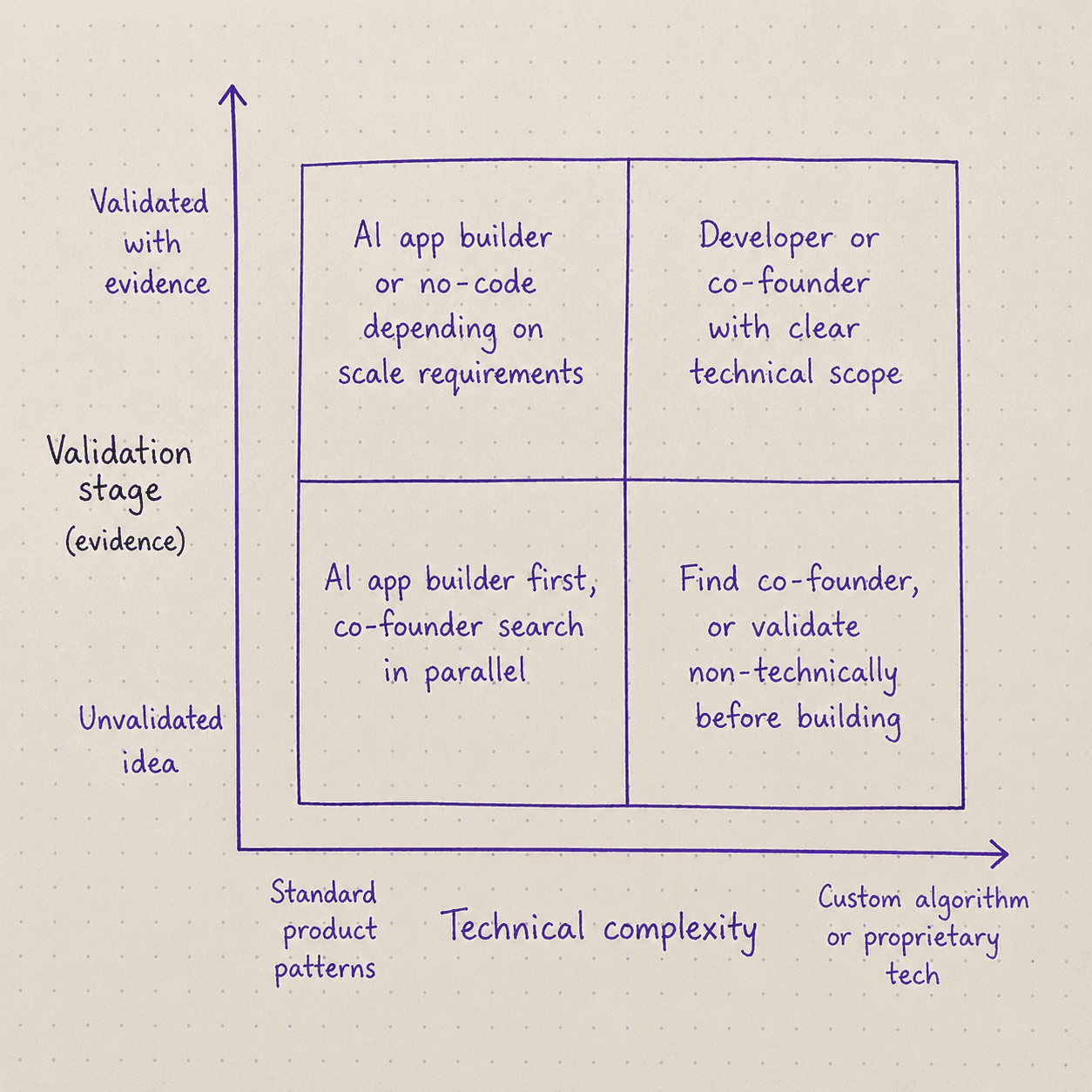
The four variables that drive the decision:
Timeline. If you need something in the market in weeks, developer hiring and co-founder searching are not realistic at that speed. No-code tools and AI app builders are. If you have six months before you need to show anything, the co-founder search has room to work.
Budget. If you have ₹5 lakh or less of runway before you need to prove the idea, spending ₹2–4 lakh on a developer for an unvalidated first version is a large bet. Platform costs of ₹2,000–6,000 per month preserve runway for what comes after the first build.
Validation stage. The less validated the idea, the less you should spend testing it. An idea in a Notion doc deserves a minimum viable build, not a polished product. An idea with paying customers warrants a proper investment.
Equity tolerance. If your competitive advantage is technical — a proprietary model, an infrastructure innovation — equity for a technical co-founder is probably the right trade. If your advantage is distribution, domain knowledge, or customer relationships, giving away 30% of the company for technical execution that a platform can handle is worth questioning before you do it.
The sequence most non-technical founders get wrong — and the order that works
The sequence I see most often: founder has an idea, hires a developer or searches for a co-founder, spends three to six months and significant money or equity, builds something nobody wants, starts over.
The sequence that works better:
Start with the cheapest test of your core assumption. Before you build anything, find out if people want what you're describing. Conversations, a landing page with a waitlist, and a rough prototype you can show to ten potential users. This takes days or weeks, not months.
Build the smallest working version using the least expensive adequate tool. If the idea survives the first test, build the smallest version that a real user can actually use — not a prototype, an application that works — using whatever costs the least while still producing something real. For most standard products, an AI app builder produces them faster and more cheaply than any other option.
Validate with real users. Get it in front of people who are not your friends. See if they use it, pay for it, and return to it. This is the evidence that changes every subsequent conversation with co-founders, with developers, with investors.
Bring in technical expertise where the product has outgrown what tools can do. At this point, you have evidence, users, and possibly revenue. The co-founder or developer conversation happens from a position of demonstrated traction, not potential.
That sequence is not glamorous and does not produce a great founding story. It has a much higher completion rate than the alternatives.
Frequently asked questions
Do I really need a technical co-founder to build a startup?
How much does it cost to hire developers to build an MVP in India?
Can I use a no-code tool to build a startup that scales?
How long does it take to build an MVP with an AI app builder?
Will investors take my startup seriously if it was built without a developer?
At what point do I actually need to bring a technical person onto the team?
Abhishek writes about the non-technical founder journey — the false starts, the financial lessons, and what actually changes when you ship something with real users. He consults during the week and builds on weekends.