Vibe coding is a software development approach in which you describe what you want to build using natural language prompts, and an AI agent generates the complete application, including code, infrastructure, and deployment, without requiring you to write code yourself. The term entered common usage in early 2024, but it describes a capability shift that had been accumulating for at least two years before anyone had a name for it. Understanding what vibe coding actually is requires separating it from three things it's frequently confused with: no-code platforms, low-code tools, and AI code assistants. These are distinct categories, and the distinctions matter more than most introductory articles acknowledge.
The definition: what vibe coding means in practice
At its most direct: you open a vibe coding platform, write a description of the application you want to build, and the AI agent produces working software. Not a wireframe. Not a component library. Working software — with a database, user authentication, API routes, and a deployed URL you can share with someone immediately.
The "vibe" in vibe coding refers to the nature of the interaction. You're not specifying logic formally. You're not writing function signatures or defining data schemas by hand. You're communicating intent — describing the product you have in your head, and the AI is doing the translation into code. The process feels less like programming and more like briefing a very fast engineer who doesn't need sleep.
This is not a metaphor for a limited autocomplete feature. The output is a complete codebase. The better platforms produce indistinguishable applications, at the code level, from applications written by a developer, because they are written by one, in the sense that the code is real, executable, and extensible. What's changed is who (or what) wrote it.
Where the term came from and why it caught on
"Vibe coding" was popularised by Andrej Karpathy in a post in February 2025, where he described the experience of building software by feel, surrendering to the AI's output, steering by vibe rather than specification. The framing was partly playful, but it captured something technically real: AI language models had crossed a threshold where they could hold enough context about a software project to generate not just code fragments but entire coherent systems.
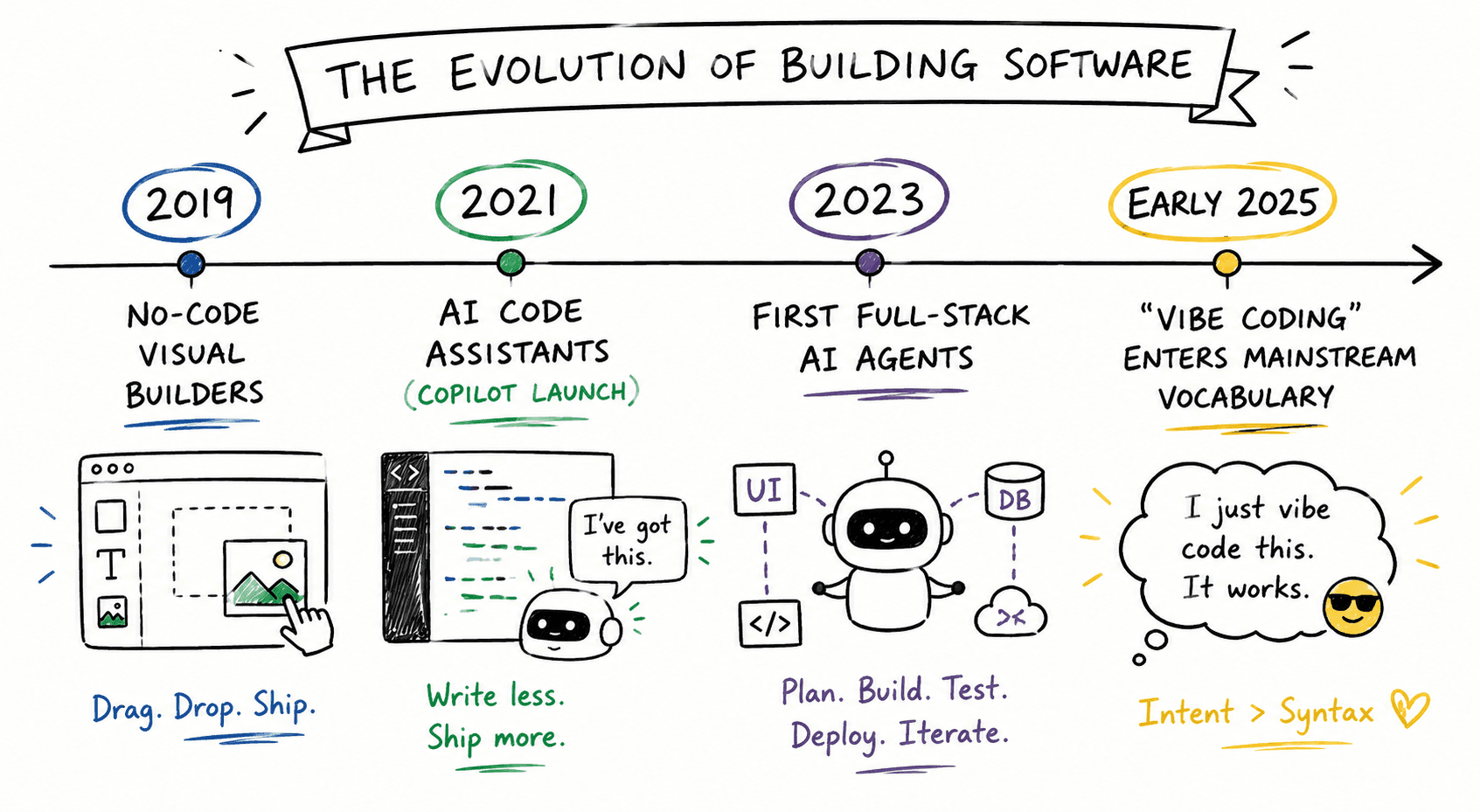
The term caught on for a straightforward reason: it named a practice that was already happening without a name. Developers had been using tools like GitHub Copilot since 2021, but Copilot was an assistant — it helped developers write code faster, it didn't replace the developer's need to understand what was being written. By 2023, a different class of tool had emerged: agents capable of taking a project description and generating an entire application structure. This wasn't possible in 2021. It was unreliable in 2022. By mid-2024, it was routine on several platforms.
The timeline matters because the term "vibe coding" is sometimes applied retroactively to tools that predate the actual shift in capabilities. A drag-and-drop website builder from 2019 is not vibe coding. A tool that generates a complete full-stack application from a single prompt in 2024 is. The distinction is not branding — it reflects a genuine change in what AI systems can do.
How vibe coding differs from no-code, low-code, and AI code assistants
This is the taxonomy question, and it's worth taking seriously because the confusion between these categories causes real problems for founders trying to evaluate tools.
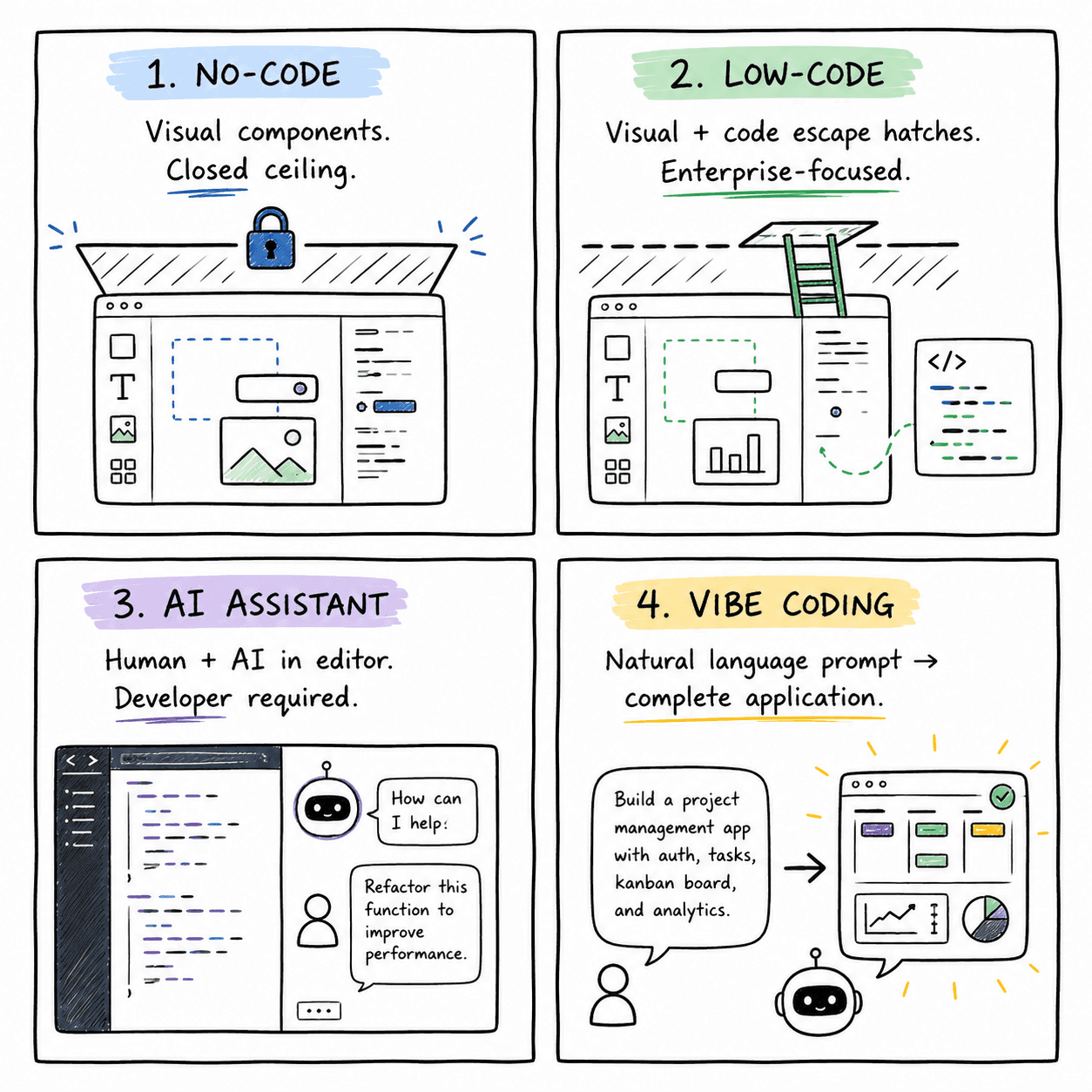
No-code platforms (Bubble, Webflow, Glide, and their peers) give you a visual editor and a set of pre-built components. You assemble an application by connecting and configuring those components. The ceiling is determined by which components the platform provides and how it has designed its logic layer. You're working within a closed system. When you outgrow the platform's capabilities, you have a problem that cannot be solved by working harder inside the platform — you have to rebuild elsewhere.
Low-code platforms (OutSystems, Mendix, Microsoft Power Apps) occupy a middle ground: they provide visual abstractions for common patterns but allow developers to drop into code when the abstractions don't cover a use case. They require at least some technical literacy and are primarily aimed at enterprise development teams, not solo founders.
AI code assistants (GitHub Copilot, Cursor, Windsurf, Antigravity) work inside a code editor, alongside a developer who is already writing code. They autocomplete, suggest implementations, explain errors, and refactor. They require the developer to have a mental model of the codebase and the ability to evaluate generated suggestions. They accelerate developers. They don't replace them.
Vibe coding is different from all three. The input is natural language. The output is a complete application. There is no visual component library you're selecting from, no code editor you're working inside, no pre-existing project structure you're extending. The AI generates the entire system from a description.
Two additional distinctions worth marking:
Ownership. No-code platforms produce applications that run on the platform's infrastructure and are expressed in the platform's proprietary format. If the platform changes pricing, closes, or deprecates a feature, your application is affected. Vibe coding on the better platforms produces a real codebase you own. The code is standard — it runs anywhere a standard application runs.
Ceiling. No-code tools have a defined feature ceiling. Vibe coding produces code that can be extended by a developer in the normal way — there is no proprietary barrier to extension.
What happens technically when you vibe code (the prompt-to-app pipeline)
The mechanics, stripped of mystification: you write a prompt. The AI agent parses that prompt and generates a plan — essentially a specification of what the application needs: which entities, which relationships, which user flows, which integrations. From that plan, it generates code across the full stack.
On the frontend, this means component structure, routing, and UI logic. On the backend, this means API routes, business logic, and database interaction. For the database itself, this means a schema consisting of tables, columns, relationships, and constraints. For deployment, this means configuration files that tell a hosting environment how to run the application.
The agent does all of this in sequence, maintaining consistency across layers. A change in the data model propagates correctly to the API and the frontend because the agent holds the full context. This is the capability that wasn't available in 2022: not just code generation, but coherent full-stack code generation where the layers actually fit together.
What's not happening: the AI is not "understanding" your business in any deep sense. It's pattern-matching your description against patterns it has seen in millions of codebases. This is why vibe coding works well for standard application patterns — task managers, booking systems, dashboards, marketplaces — but starts to struggle when you need genuinely novel logic that doesn't align with common patterns.
The spectrum: frontend-only tools vs full-stack platforms
Not all vibe coding tools are equivalent, and the most important axis of difference is what they generate behind the frontend.
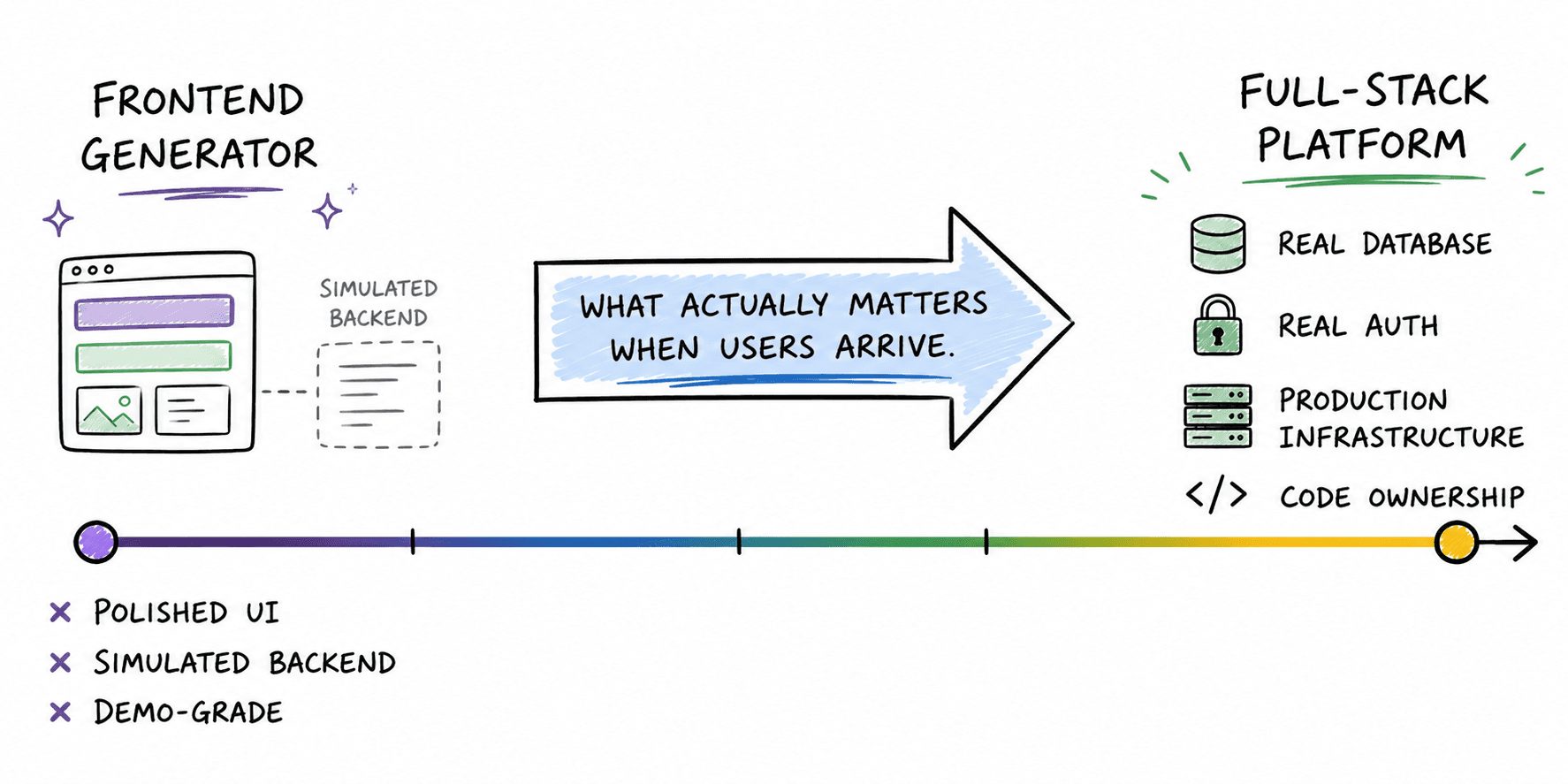
Some platforms generate excellent frontend code — polished React components, responsive layouts, smooth interaction design — connected to a backend that is either simulated or limited. The application looks complete. In a demo, it is complete. Under real user traffic, with real data persistence requirements, it isn't. The database is often an in-memory store that doesn't persist across sessions, or a managed service that creates a dependency the founder doesn't fully control. Authentication is sometimes placeholder logic rather than a real implementation.
Other platforms generate the complete stack: a real database, real authentication, real API infrastructure, and deployment configuration designed to handle actual traffic. The distinction is not visible in a screenshot or a five-minute demo. It becomes apparent when you put the application in front of users, and they expect their data to be there the next time they log in.
This distinction matters more than any feature comparison on a marketing page. A frontend-only output is a prototype. A full-stack output is a product. The former needs to be rebuilt before it can go to production. The latter doesn't.
Mayson is an example of a platform built around the full-stack premise. The design principle is that a founder describing their first application shouldn't receive something that needs rebuilding when real users arrive — so the generated infrastructure includes real databases, real auth, and a scalable backend architecture from the first prompt. You own the repository and the codebase outright, with no platform dependency baked into the output.
Real examples of what vibe coding can build today
The category is new enough that what's "realistic" keeps expanding, so this section is anchored in what's demonstrably working now rather than projections.
Vibe coding handles standard application patterns reliably. A task management tool with user accounts, team workspaces, and a persistent database — the kind of internal tool many teams currently run on spreadsheets. A booking system where service providers list availability and customers schedule appointments, with calendar integration and email notifications. A simple two-sided marketplace connecting supply and demand for a specific vertical. A client portal where customers can log in, see their data, submit requests, and track status—a CRM-adjacent tool built for a specific industry workflow that generic CRMs handle badly.
What these have in common: they follow patterns that AI systems have been trained on extensively. Auth, database, CRUD operations, role-based permissions, third-party integrations — these are the building blocks, and the agents generate them reliably.
The category also handles internal tools particularly well. An inventory tracker for a small manufacturer. A reporting dashboard pulling from a database that currently lives in a spreadsheet. An onboarding workflow tool for a team that's been managing the process in email threads. These applications have low design requirements and high functional requirements — exactly the profile where vibe coding performs best.
The limitations and where traditional development still wins
Complex state management. Applications where many things can be happening simultaneously, where the state of the system is intricate and needs to be managed precisely — these stretch what current AI agents handle well. A simple to-do list has a simple state. A real-time collaborative editing tool has a complex state. The gap between these is not just technical complexity; it's the kind of architectural thinking that benefits from experienced engineering judgement.
Highly custom business logic. Vibe coding works by recognising patterns. When your application requires logic that doesn't map to common patterns — a novel pricing algorithm, a domain-specific calculation engine, a workflow with unusual branching conditions — the AI is guessing. Sometimes it guesses correctly. Often it doesn't, and diagnosing why requires the kind of understanding that the AI itself lacks about your specific domain.
Fine-grained design control. AI-generated interfaces are functional and, on the better platforms, reasonably polished. They are not the output of a designer who has spent weeks on interaction details and visual hierarchy. For consumer applications where the design is the product, where how something feels is central to why users choose it, vibe coding provides a starting point, not a finished product. This isn't a permanent limitation; design can always be refined. But it's worth setting expectations correctly.
Security-critical systems. Applications handling sensitive data — financial transactions, medical records, legal documents — require a security review that goes beyond checking whether the generated code runs. AI agents don't currently produce audited, security-reviewed code as a default output. Some platforms are working toward this; none have solved it definitively.
The honest summary: vibe coding is a legitimate and powerful tool for a specific range of applications. It is not a replacement for experienced software engineering on complex, novel, or security-critical systems. Knowing where the boundary sits is what makes it useful rather than frustrating.
Frequently asked questions
Is vibe coding the same as no-code?
Do I need to know how to code to use Vibe coding tools?
Can vibe-coded apps handle real users and traffic?
What's the difference between vibe coding and using GitHub Copilot?
Are vibe-coded apps just prototypes or can they be production-ready?
How much does vibe coding cost compared to hiring developers?
Shashi has written about developer tools and the no-code/low-code space for eight years, covering the category from its Bubble-era origins through the current AI-agent moment. She runs a developer tools newsletter from Delhi, has interviewed founders at Bubble, Webflow, Retool, and Replit, and has never built a production app herself — a fact she considers a professional asset rather than a liability when explaining things to people who also haven't.