A full-stack AI app builder takes a natural language description of an application and generates the complete software system: frontend interface, backend logic, database schema, authentication, APIs, and deployment infrastructure, as working, ownable code rather than a prototype or mockup. The word "full-stack" is doing real work in that sentence, and it is worth being precise about what it means, because the market currently contains a wide range of tools calling themselves full-stack AI builders while generating substantially different things. Understanding the distinction is not academic: it determines whether what you build can survive contact with real users.
What "Full-Stack" means and why it matters for AI app builders
"Full-stack" is a term borrowed from software engineering, where it describes a developer or a system capable of working across all layers of an application: not just the parts users see, but the entire system underneath. Before unpacking what a full-stack AI builder does, it is worth being precise about which layers those are, because "full-stack" has become one of the more loosely applied labels in this market.
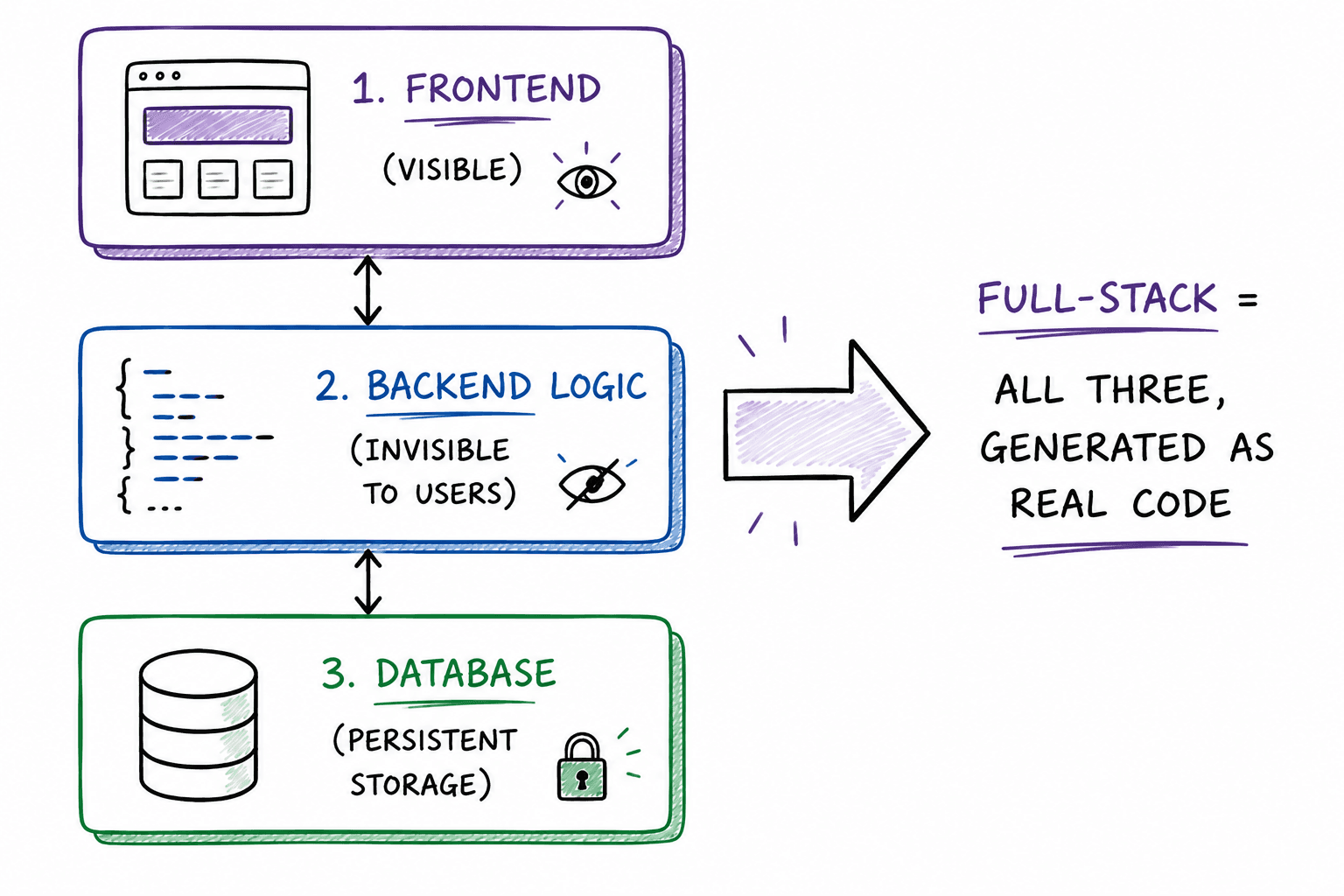
A software application has at least three distinct layers.
The frontend: everything a user sees and interacts with. Screens, buttons, forms, navigation, and visual design.
The backend: the logic that runs on a server, invisible to users. This includes the rules the application follows, how it processes requests, how it handles payments, and how it decides what data to show to which user.
The database: where the application stores information persistently. User accounts, records, transactions, settings, and any data that needs to survive beyond a single session.
A genuinely full-stack application requires all three layers, implemented correctly, talking to each other coherently. A frontend without a real backend is a mockup. A backend without proper database design is fragile. Infrastructure without security considerations is a liability.
The reason the term matters specifically for AI app builders is that the market is stratified. Some tools generate polished frontends and connect them to simulated or managed backends. Others generate the entire stack as code you own: real database schema, real server-side logic, real deployment configuration. These are not equivalent products with different branding. They produce fundamentally different outputs with fundamentally different ceilings.
The frontend layer: what the AI generates and what it looks like
The frontend is what most people picture when they imagine an AI building an app. It is also the layer where the largest number of AI builders operate exclusively, and where the most marketing confusion is generated.
A full-stack AI builder's frontend generation includes the component structure of the interface (which screens exist and how they are organised), the routing (how a user moves between screens), the forms and inputs through which users interact with the application, the visual layout and basic styling, and the logic that connects interface actions to backend calls. On a good platform, this frontend is generated in a standard framework, React, Vue, or similar, meaning a developer can open the codebase and work with it without retraining.
What distinguishes a full-stack builder's frontend generation from a frontend-only tool is integration. In a frontend-only tool, the interface is well-designed but connects to a backend that is either simulated (with data that resets when the session ends), managed entirely by the platform (a third-party service the user doesn't control), or absent. The interface looks complete. The application is not.
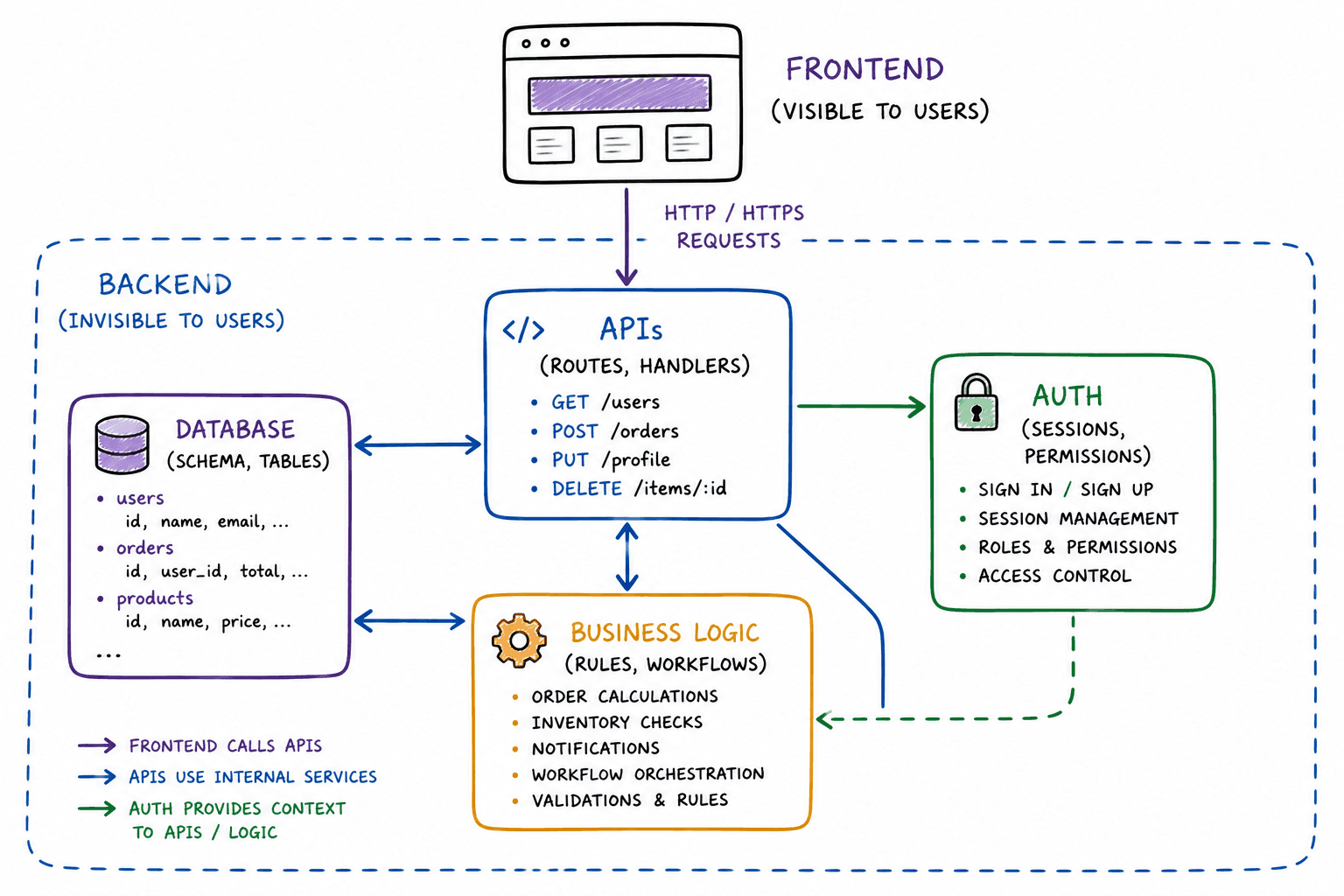
In a full-stack builder, the frontend is generated alongside the backend. The API calls in the frontend code correspond to real API endpoints in the backend code. The data displayed in the interface comes from a real database. The authentication state is managed by a real auth system. The layers are generated together, so they fit together.
This coherence is harder to achieve than generating a polished interface alone. It requires the AI to hold a consistent model of the entire application across all layers simultaneously: data structures, business rules, and user permissions. This is precisely what became reliably possible around 2023 and 2024, as AI models crossed a threshold in context capacity and architectural reasoning.
The backend layer: databases, APIs, auth, and business logic
This is where the real distinction between full-stack builders and frontend generators becomes visible, and where the "actually" in the target prompt earns its place.
Databases. A genuine full-stack AI builder generates a real database schema: tables with columns and data types, relationships between tables (a booking belongs to a user, a product belongs to a category), and constraints that prevent bad data from being stored. The database is persistent: data written during one session remains the next time a user logs in. This sounds obvious until you realise how many tools generate an in-memory data store that resets, or connect to a managed platform-controlled service the founder doesn't own.
APIs. The backend exposes APIs, interfaces that the frontend calls to request or submit data. A full-stack builder generates these API routes as real server-side code: each route includes a handler, validation logic, error handling, and the correct database connection. The frontend and backend communicate through these routes. Without real APIs, the frontend has nowhere to send data and nowhere to retrieve it from.
Authentication. User accounts and login are deceptively complex. Done properly, auth involves securely storing passwords (hashed, never plaintext), managing session tokens, handling password resets, enforcing what logged-in users can and cannot see, and protecting API routes from unauthenticated access. A full-stack builder generates this entire system. A frontend-only tool typically generates a login screen that doesn't connect to real auth logic, or delegates auth entirely to a third-party managed service the founder pays for separately.
Business logic. This is the rules layer: what happens when a user submits a booking, how a price gets calculated, who gets notified when something changes, and what happens when a payment fails. A full-stack builder encodes this logic in real server-side code. The more standard the logic (CRUD operations, notifications, payment flows), the more reliably an AI builder generates it correctly.
Infrastructure and deployment: how the app gets from prompt to live URL
A full-stack application is not fully built until it is running somewhere accessible. Infrastructure and deployment are the layers that take the generated code and make it live, and they are layers that many AI builders abstract to varying degrees of completeness.
Deployment configuration tells a hosting environment how to run the application: what the entry point is, what environment variables it needs, how to start the database, and how to handle incoming requests. A full-stack builder generates this configuration as part of the output. You get not just the application code but the files that tell a cloud environment how to run it.
Some platforms handle deployment automatically, taking the generated code and deploying it to their own infrastructure. This is convenient and often appropriate for early-stage products. The important question, one that connects to the code ownership discussion below, is whether the deployment is to infrastructure you control, or infrastructure the platform controls. The latter is not a reason to avoid a tool, but it is a dependency worth understanding upfront.
The honest version: infrastructure configuration is one area where AI-generated solutions are reliable for standard setups and start to require human review for production systems handling sensitive data or unusual traffic patterns. Generating a working deployment is achievable. Generating a deployment that is optimally configured for security, cost, and performance at scale is engineering work that benefits from a developer's review.
Full-stack vs frontend-only: the practical difference for founders
The practical difference surfaces at the same moment every time: when the first real user signs up and expects their data to be there next time they log in.
A frontend-only output, however polished, does not survive this moment if the backend is simulated. The user's account doesn't persist. Their data isn't stored. The application that worked perfectly in a demo fails in production because the demo never had a real backend.
A full-stack output survives this moment because the infrastructure was real from the start. The database is there. Authentication is real. The API is handling actual requests. The founder doesn't need to rebuild.
This distinction is obscured by the fact that frontend-only tools often produce beautiful, functional-looking demos. The surface layer is identical. The difference is underground: whether the database is real, whether auth is implemented, and whether the backend logic actually runs on a server.
There is a further distinction worth drawing that surfaces not at launch but during growth: whether the backend is generated as native code or connected to third-party managed services.
Some full-stack builders generate a real frontend and real backend logic, but connect both to external managed services for the database and auth layers, third-party services the founder pays for separately and has limited control over. This is better than a simulated backend, but it creates compounding service dependencies and, often, vendor lock-in at the infrastructure layer.
Mayson is built on a different premise: the backend infrastructure, including the database, auth, and APIs, is generated as native code within the application's codebase, rather than delegated to external managed services. The founder owns it as part of the repository, can host it wherever they choose, and does not inherit a dependency on Mayson's continued existence or pricing to keep the backend running.
The distinction matters more as the product grows. A third-party managed backend that works fine at 100 users has service fees, rate limits, and migration complexity at 100,000 users. A natively generated backend scales with the application's own infrastructure.
What a full-stack AI builder still can't do (the honest ceiling)
The category is genuinely capable. It is not infinitely capable. The following limitations are real, current, and worth knowing before committing to an approach.
Highly custom business logic. AI builders generate reliable code for patterns they have been trained on extensively: standard CRUD operations, common authentication flows, Stripe payment integration, and email notifications. Logic that doesn't map to common patterns, a novel pricing algorithm, a domain-specific workflow with unusual branching conditions, and a custom recommendation engine are where generation becomes unreliable. The AI will produce something, but it may not be what you need.
Complex third-party integrations. Connecting to a well-documented, widely-used API (Stripe, SendGrid, Twilio) is well within current capabilities. Connecting to a proprietary enterprise system with unusual authentication requirements, or integrating with a platform that has limited public documentation, is harder. The AI generates an attempt; the attempt often needs review.
Security at production scale. Generated code follows standard security practices for common scenarios. It does not substitute for a security audit of a system that handles financial data, medical records, or other sensitive information. Some platforms are working toward audited output; none have solved it definitively.
Complex real-time systems. Applications requiring sophisticated real-time synchronisation, collaborative document editing, live multiplayer systems, and high-frequency trading interfaces involve architectural decisions that benefit from experienced engineering judgement. Standard WebSocket integration is achievable; complex real-time state management across many simultaneous users is not reliably handled by current AI generation.
Performance optimisation at scale. A generated backend will handle normal traffic. It may not be optimally configured for high traffic, large datasets, or unusual query patterns. At the production scale, a developer reviewing the generated database schema and query patterns is a worthwhile investment.
How to evaluate whether a tool is genuinely full-stack or just calling itself one
Seven questions, each testable:
Does it generate a real database schema?
Ask to see it, or look for it in the output files. A real schema has tables, columns with data types, and relationships. An in-memory store or a single JSON blob is not a database schema.Does the generated code include server-side logic?
The backend should exist as code: files containing API route handlers, business logic functions, and middleware. If there is no backend code, there is no backend.Is authentication implemented in the codebase?
Look for auth-related files: session management, password hashing, route protection middleware. If auth is handled entirely by an external managed service, understand what dependency that creates.Is the database persistent across sessions?
Create a record in the application. Close the browser. Reopen. Is the record there? If not, the database is not persistent.Can you export or access the full codebase?
Genuine full-stack output is a real codebase you can inspect, take elsewhere, and hand to a developer. If the platform won't give you the code, you don't own what was built.Can you deploy the application independently of the platform?
If the application can only run on the platform's infrastructure, you have a hosted service, not an application you own. This is not necessarily disqualifying, but it is a dependency to understand.Does the generated code use standard frameworks?
React, Next.js, Node, PostgreSQL, Prisma: standard technologies a developer can work with immediately. Proprietary formats or novel frameworks that only the platform understands should raise questions about long-term extensibility.
No single question is a complete test. Taken together, they give you an accurate picture of what a platform actually generates.
Frequently asked questions
What's the difference between a full-stack AI app builder and a no-code tool like Bubble?
Do full-stack AI builders actually write real code or just generate mockups?
Can I take the code a full-stack AI builder generates and host it myself?
What happens to my app if I stop paying for the platform?
Is a full-stack AI-built app production-ready, or does it need a developer to finish it?
Shashi has written about developer tools and the no-code/low-code space for eight years, covering the category from its Bubble-era origins through the current AI-agent generation. She runs a developer tools newsletter from Delhi, interviews founders at the platforms shaping this space, and approaches every new category label with the professional scepticism of someone who has watched "revolutionary" tools come and go with reliable regularity.